|
Colonel J M Craster
Late Grenadier Guards
by Lieutenant Colonel Alexander Héroys
formerly Grenadier Guards
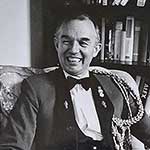
|
Colonel J M Craster, always known as ‘Mike’, was a typical English/Scottish gentleman. Mild-mannered, well-educated (at Oxford) and the laird of Craster Tower, Craster, Northumberland, where his family had owned land thereabouts since 1278 and had been resident in the tower since its original construction in 1415. He was always full of laughter with a mischievous sense of humour and loved the ridiculous. ‘Long live lunacy’!
Educated at Ardvreck and Wellington College (where his grandfather had been a former headmaster), he then had a year in France at the Sorbonne, working for Moët and Chandon in Beaune to perfect his French, which proved very useful later in his career.
He joined the Argyll and Sutherland Highlanders in Edinburgh, before taking up a military scholarship to Balliol College Oxford, where he stroked the first eight at Henley. At Oxford he met and married the love of his life, Fiona, the sister of a brother Argyll officer.
Then, in the role of the relatively new concept of a graduate officer, he was thrust into the operational posting of the Aden emergency at its height in 1967. He was not an obvious fit with the steely-eyed man-of-action that was his Commanding Officer, Lieutenant Colonel ‘Mad’ Mitchell, who greeted him with the harsh command: ‘Get down into the Crater and grow up!’
History records ‘Mad Mitch’s’ decision, in defiance of his orders from above, to march his Battalion down into Crater with pipes playing and drums beating.
On leaving Aden, Mike was posted to Troon where in 1970, just as the Argylls were being disbanded in the latest round of defence cuts, a chance meeting between Fiona and Julia Denison-Smith led to the plan for Mike to become a Grenadier being hatched.
On joining the Regiment in 1971 Mike was first posted to 14th Company to learn the mysterious ways of the Regiment.
When the Argylls were reinstated in 1972 the Colonel, Major General Sir Alan Adair, at the Northumberland Regimental Association Branch dinner let Mike know that: ‘Of course, you may well want to go back, but we very much hope you will stay with us’. So impressed was Mike by this magnanimous offer that he directly resolved to remain a Grenadier.
In 1973 Mike was posted to JOC Maastricht for two years. The HQ was in a cave, originally dug into the hillside by the Romans, and in WW2 the Nazis greatly enlarged it with miles of tunnels, lagging all the pipes and cables with asbestos – with disastrous implications for all those who worked there.
In 1977/78, he commanded Number Two Company of the 2nd Battalion in the Creggan camp in Londonderry which required a tricky balancing act between initiating proactive community relations and dealing with an IRA hit team on the loose with a M62 machine gun!
His tour of duty in Berlin in 1979/1981 introduced him to the international, political and diplomatic dimensions of life which would serve him so well later on.
As Senior Major of the 1st Battalion in 1982 in Kenya, he earned fame for his ability to demolish the Muthaiga Club pudding trolley against all contenders. On one epic journey across the Aberdares (recorded in The Guards Magazine) he unfairly encountered the fury of an enraged mother elephant at the loss of her baby in a ‘cot-death’ incident.
He was most at ease in his command appointment as the Commanding Officer of the Oxford University Officers Training Corps where his combined experience as a former university student there, his operational experience in Aden and Northern Ireland, and his shrewd insight of character, enabled him to deal with the diverse challenges of the job.
In the 1980s he wrote a series of articles in The Guards Magazine positing a future restructuring of the Household Division in the light of the threat of continuing defence cuts. So accurate were these innovative ideas (almost predicting what now exists) that the then Major General forbad further discussion for fear of them being prematurely implemented!
On promotion to Colonel, he held two important positions as the Defence Attaché in Vienna, and subsequently the Defence and Military Attaché in Brussels/Luxemburg. His interesting and interested personality, and his language skills, enabled him to easily mix with and form good relations with the international and diplomatic set.
He retired in 1994 to his home at Craster Tower in Northumberland where he worked for the NHS for several years dealing with complaints and grievances with consummate skill. ‘In recognition of mistakes made, would you prefer to receive a cash payment, or would you rather that money was put towards a new MRI scanner?’
He then, for over 30 years, took up the life of the country gentleman, supporting local charities and greatly encouraging the development of the small, but notable (for its kippers), Northumberland village of Craster. As Chairman of the Parish Council, he vigorously defended the interests of the villagers, and as a key member of the Craster Local History Group, his scholarship was much in demand.
With his academic bent, Mike wrote the well-received Fifteen Rounds a Minute, The Grenadiers at War, August to December 1914, Edited from Diaries and Letters of Major ‘Ma’ Jeffreys et al which was first published in 1976 by MacMillan London Limited and later republished in 2012 by Pen and Sword Military.
Finally, and most unreasonably, as a consequence of his staff officer days in Maastricht, asbestosis in later life caught up with him. Never losing his sense of humour, he underwent a desperate and gallantly fought battle against cancer for nearly two years before finally letting go on 8th October 2025.
He married Fiona Reddish in 1966. She survives him with their two daughters, Victoria and Antonia, and three grandchildren. |
|